How to Build a Nootropic Stack Safely: A 2026 Framework
Quick Answer: How Do You Build a Nootropic Stack Safely?
Start with one base ingredient, then add one variable at a time. Use the classic caffeine + L-theanine pairing (roughly 100 mg caffeine to 200 mg theanine), pair any acetylcholine-active herb with a choline source, cap the stack at three to five ingredients, and log dose, timing and response for one to two weeks before changing anything. Respect label serving sizes; never megadose.
- One variable at a time so you can read your own response cleanly.
- Classic synergy: 2:1 theanine-to-caffeine smooths the jitters.
- Cap it: 3–5 ingredients keeps the stack legible and safe.

What "stacking" actually means — and where it goes wrong
A nootropic stack is simply a combination of cognitive-support ingredients taken together with the intention that they work better as a set than any one of them alone. The idea is sound. Caffeine and L-theanine genuinely complement each other; a choline precursor genuinely supports a cholinergic herb. The trouble is that "stack" is also the word people reach for when they buy nine bottles, take a handful each morning, and then cannot say whether they feel sharper, jittery, or exactly the same.
Almost every avoidable problem with stacking comes from the same root error: changing several things at once. If you add three ingredients on Monday and feel wired and headachy by Wednesday, you have no way to know which one did it, or whether the culprit was actually a bad night's sleep. The framework below exists to prevent that. It is deliberately conservative, it favours ingredients with a real human evidence base, and it treats your own logbook as the most important piece of equipment you own.
Rule 1: Start with one base, then add one variable at a time
Pick a single foundation and run it on its own long enough to know how it feels. For most people the natural base is a well-tolerated, fast-reading ingredient — caffeine is the obvious candidate because you almost certainly already know how your body handles it. Once that base is stable, you add exactly one new ingredient and hold everything else constant: same base, same dose, same time of day.
This is not caution for its own sake. It is the only way to generate readable information. When you change one variable, any change you notice is attributable. When you change three, you have learned nothing you can act on. Scientists call this controlling your variables; for a stack, it is the difference between building something and just accumulating bottles.
Rule 2: The classic synergy — caffeine plus L-theanine
The best-documented beginner combination in the entire category is caffeine with L-theanine, the calming amino acid found in tea. Caffeine delivers alertness and faster reaction time; L-theanine takes the rough, jittery edge off it. Human studies of the combination have reported improvements in attention-switching and accuracy that were larger than caffeine alone, alongside reduced self-reported jitteriness (Owen and colleagues, 2008; Haskell and colleagues, 2008).
The ratio people converge on is roughly 2:1 theanine to caffeine — commonly around 200 mg of L-theanine to 100 mg of caffeine. That 100 mg of caffeine is about one strong cup of coffee, which matters for the next point: whatever caffeine is in your stack stacks with your coffee, tea, cola and energy drinks. The FDA's population reference for healthy adults is about 400 mg of caffeine a day, so run the arithmetic before you add a stimulant on top of a coffee habit. Take the caffeinated part of any stack earlier in the day, and read our companion piece on how L-theanine changes the way caffeine feels if this is your starting point.
Rule 3: Pair a choline source with any acetylcholine-active herb
This is the one pairing that beginners most often miss. Ingredients such as huperzine A raise the availability of acetylcholine, the neurotransmitter most associated with learning and memory. Huperzine A does this by slowing the enzyme that breaks acetylcholine down. The community's long-standing concern is that if you push the cholinergic system harder while your dietary choline intake is low, some people report dull tension headaches during heavy mental work.
The usual answer is to pair the cholinergic herb with a choline source — citicoline (CDP-choline) or alpha-GPC are the two most common — on the logic that you are supplying the raw material as well as slowing the breakdown. Be honest about the evidence here: the "prevents depletion headaches" story is largely anecdotal rather than proven in controlled trials, and citicoline and alpha-GPC also have their own modest evidence for attention and memory endpoints. Treat the pairing as a sensible, low-cost precaution rather than a guaranteed fix, and always stay within label serving sizes. If you want the head-to-head, see alpha-GPC versus citicoline for choline and memory.
Rule 4: Keep the total stack to three to five ingredients
There is no law that says six ingredients are dangerous and five are safe. The ceiling is about legibility, not toxicity. Every ingredient you add multiplies the possible interactions and, just as importantly, blurs your ability to attribute any effect. A five-ingredient stack has ten possible pairwise interactions; a ten-ingredient stack has forty-five. You cannot reason about forty-five interactions, and neither can most clinicians without a database.
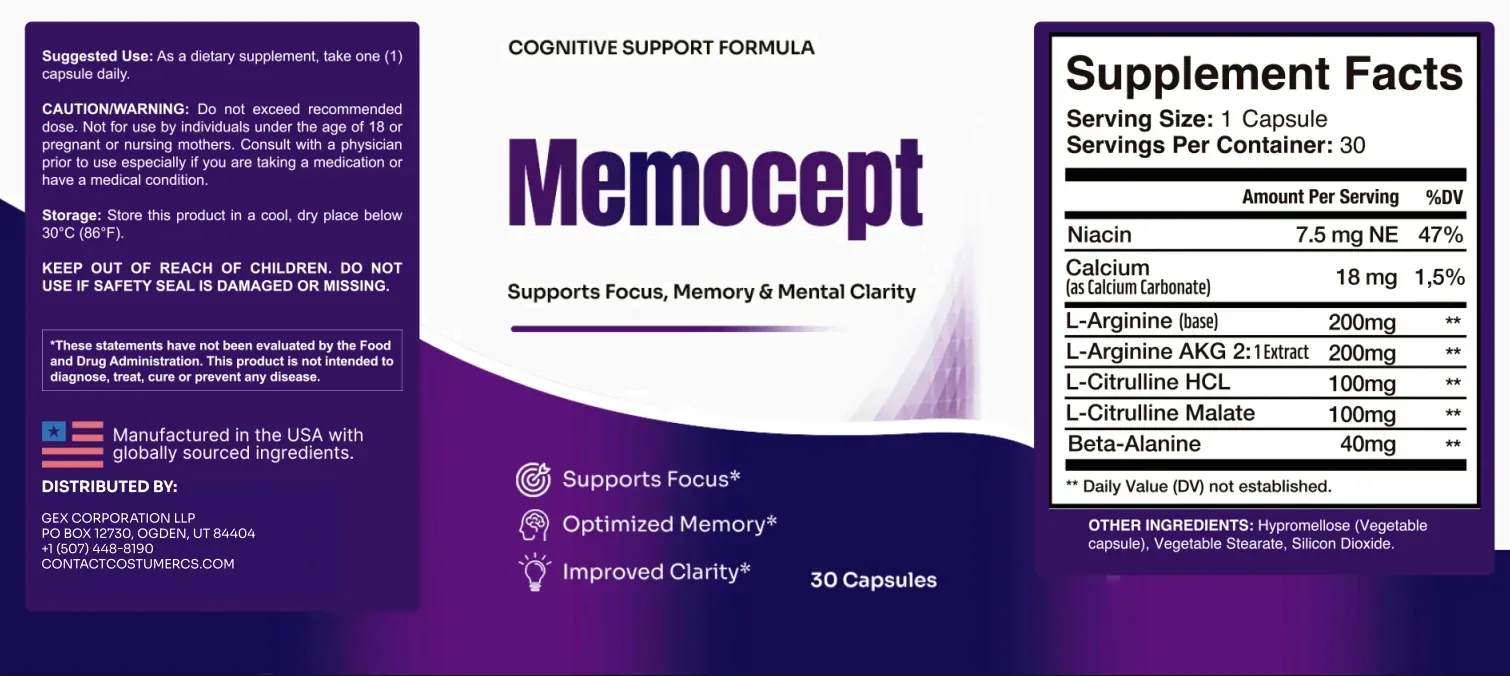
A small stack is also cheaper, easier to time, and easier to abandon when it is not working. This is one reason a sensibly built multi-ingredient formula can be a reasonable base: it gives you a fixed, labelled set of actives to react to, rather than a moving target. Memocept, for example, is a five-active formula — Bacopa monnieri, Huperzine-A, Rhodiola rosea, L-Tyrosine and caffeine from green coffee — which already fills the three-to-five range before you add anything of your own.
Rule 5: Log dose, timing and response for one to two weeks
The logbook is the framework. For each change, write down three things every day: the dose you took, the time you took it, and how you felt — focus, mood, sleep, any headache or jitter. Hold that for one to two weeks before you change anything, because a single good or bad afternoon is noise. Sleep and consistency swamp the effect of most single doses, so a week of the same routine is what turns noise into signal.
Some ingredients demand far more patience. Bacopa monnieri's memory effect is cumulative and typically shows up over roughly eight to twelve weeks of daily use, not in a day (Stough and colleagues; Calabrese and colleagues). Judging Bacopa after three days is like judging a fitness programme after one workout. Build the timeline into your expectations before you start, and let the log — not a hopeful mood — drive the next adjustment. Our guide on how to tell if a nootropic is working covers what a readable signal actually looks like.
A sample beginner-to-intermediate progression
| Week | What you change | Why |
|---|---|---|
| 1–2 | Base only (e.g. moderate caffeine, timed early) | Learn how the base feels alone; establish a baseline in your log |
| 3–4 | Add L-theanine at ~2:1 to the caffeine | Smooth the jitter; confirm the pairing suits you |
| 5–6 | Add a choline source if using a cholinergic herb | Supply the precursor alongside the acetylcholine-active ingredient |
| 7–16 | Add one cumulative ingredient (e.g. Bacopa) and hold | Give slow-building memory effects the 8–12 weeks they need |
Notice what this progression never does: it never megadoses, and it never changes two things in the same week. Higher than the label serving is not a shortcut to more benefit — for most ingredients it is a shortcut to more side effects. Respect the serving size printed on the panel, and treat "more" as the last thing to try, not the first.
Where a pre-built formula fits
If assembling and timing four or five separate bottles sounds like more project than you want, a single well-labelled formula is a legitimate base. The requirements are the same either way: every active named, every amount printed, no proprietary blend hiding the numbers. That is the only way you or a pharmacist can check the caffeine total, spot a cholinergic ingredient that warrants a choline pairing, or flag an interaction. A formula that will not tell you its doses cannot be stacked on safely, because you would be adding known ingredients to an unknown base.

Start from a labelled base, not a mystery blend
Memocept names all five of its actives — Bacopa monnieri, Huperzine-A, Rhodiola rosea, L-Tyrosine and caffeine from green coffee — with no proprietary blend, so you can build a stack on top of it with your eyes open. See the full panel on the main product page.
Order NowRelated reading
- Nootropic Cycling and Tolerance: When to Take Breaks
- Brain Fog: Real Causes and Evidence-Based Fixes
- Nootropic Myths vs What the Research Actually Shows
Frequently asked questions
What is the safest beginner nootropic stack?
The most studied and forgiving starter combination is caffeine plus L-theanine, usually around 100 mg of caffeine with 200 mg of L-theanine, a 2:1 theanine-to-caffeine ratio that smooths the jittery edge of the stimulant while keeping the alertness. It is safe as a beginner stack precisely because it is only two ingredients, both of which have a large human evidence base, so if something feels off you know exactly what changed. Start there, take it earlier in the day, count the caffeine against everything else you drink, and do not add anything for at least a week or two. A single, well-tested base beats a crowded stack every time.
How many nootropics can I safely combine at once?
For most people, three to five ingredients is a sensible ceiling. The problem with a longer list is not that ten ingredients are automatically dangerous; it is that you can no longer tell which one is helping, which one is causing a headache, and which one is doing nothing at all. Every ingredient you add multiplies the number of possible interactions and blurs your ability to read your own response. Keeping the stack small keeps it legible. If you are taking any prescription medication, the safe number to add on your own is zero until a pharmacist or doctor has looked at the specific combination.
Why add a choline source to a memory stack?
Acetylcholine-active ingredients such as huperzine A raise the availability of acetylcholine, a neurotransmitter central to learning and memory. If your dietary choline intake is low, some people report tension headaches during intense mental work, which are often attributed anecdotally to running the cholinergic system harder than the raw materials support. Pairing a choline source such as citicoline or alpha-GPC with a cholinergic herb is the community's usual answer, on the logic that you are supplying the precursor as well as slowing the breakdown. The evidence for this specific pairing preventing headaches is anecdotal rather than trial-grade, so treat it as a reasonable precaution, not a guarantee, and respect label serving sizes.
How long should I test a new stack before adjusting it?
Give any single change one to two weeks before you change anything else, and longer for ingredients that work cumulatively. Fast-acting ingredients like caffeine tell you something within an hour, but your sleep, mood and consistency over several days matter more than any single dose, so a week or two of the same dose at the same time gives you a readable signal. Some ingredients are slower still: Bacopa monnieri's memory effect builds over roughly eight to twelve weeks, so judging it after three days tells you nothing. Log the dose, the timing and how you felt each day, and let the log, not a good or bad afternoon, drive the next change.
Medical note: this article is general educational information about combining supplements, not medical advice, and it is not a substitute for a pharmacist or physician. Speak to a healthcare professional before starting or combining any supplement, especially if you are pregnant or nursing, take prescription medication, or are managing a health condition. Never adjust a prescription on the basis of a web page.
Scientific references
- Owen G.N., Parnell H., De Bruin E.A., Rycroft J.A. — The combined effects of L-theanine and caffeine on cognitive performance and mood, Nutritional Neuroscience 2008;11(4):193–198 (PMID 18681988)
- Haskell C.F., Kennedy D.O., Milne A.L., Wesnes K.A., Scholey A.B. — The effects of L-theanine, caffeine and their combination on cognition and mood, Biological Psychology 2008;77(2):113–122 (PMID 18006208)
- NIH Office of Dietary Supplements — Choline: Fact Sheet for Health Professionals (dietary sources, adequate intake, and function)
- Stough C., Downey L.A., Lloyd J., et al. — Examining the nootropic effects of a special extract of Bacopa monniera on human cognitive functioning: 90-day trial, Phytotherapy Research 2008;22(12):1629–1634 (PMID 18683852)
- Calabrese C., Gregory W.L., Leo M., et al. — Effects of a standardized Bacopa monnieri extract on cognitive performance, anxiety, and depression in the elderly, Journal of Alternative and Complementary Medicine 2008;14(6):707–713 (PMID 18611150)
- Mayo Clinic — Caffeine: how much is too much? (400 mg/day adult reference and typical beverage contents)
- NCCIH (National Center for Complementary and Integrative Health) — Asian ginseng: uses, safety and interactions
Build on a base you can actually read
A stack is only as safe as the label underneath it. Memocept names every active individually — no proprietary blend — so you can time the caffeine, place the cholinergic ingredient, and add one variable at a time knowing what is already there. Check with a clinician first if you take any medication.
Order Now